



How it works
The formula: S² × D
S is the number of separate absences, often called spells, in the period. D is the total number of days absent across all of them. Square S, multiply by D, and the result is the Bradford Factor score.
Squaring the number of spells is what makes the score different from a simple count of days off. The thinking behind it is that short, unplanned absences are harder to plan cover for than one longer absence, which is often known about in advance.
1
Count the spells
Count each separate absence in the period once, whether it lasted half a day or three weeks.
2
Square that number
Multiply the number of spells by itself. Four spells becomes 16, and ten spells becomes 100.
3
Multiply by the days
Multiply the result by the total days absent across every spell. Four spells adding up to five days scores 16 × 5 = 80.
The period
Most employers use a rolling 52 weeks, so old absences drop off as time passes. Some use the calendar or financial year. Use the same period for everyone.
What counts as one spell
An unbroken absence counts once, however long it lasts. Many policies count days off either side of a weekend or a non-working day as one spell. Say so in yours.
Half days
A half day adds 0.5 to the total days but a whole spell to the count, so two half days off is one day absent and two spells.
What to leave out
Booked holiday is not absence. Most policies also leave out absence for pregnancy, disability, and time off for dependants in an emergency.
Worked examples
The same six days, four very different scores
Each of these employees missed six days in the last 52 weeks. The only difference is how many separate times they were off. One six-day absence scores 6. Six single days score 216, thirty-six times as much.
| How the six days were taken | Across the year | Working | Score |
|---|---|---|---|
| One absence of six days1 spell, 6 days | 1² × 6 | 6 | |
| Two absences of three days2 spells, 6 days | 2² × 6 | 24 | |
| Three absences of two days3 spells, 6 days | 3² × 6 | 54 | |
| Six single days6 spells, 6 days | 6² × 6 | 216 |
Good and bad scores
What is a good or bad Bradford score?
There is no official scale. As a rough guide, a score under 50 rarely raises concern, and many employers hold a first formal absence review somewhere around 200. What actually happens depends on the trigger points in your own absence policy.
The table shows example review points some UK employers use. Treat them as a starting point when you write your own, not as a rule.
| Score | What often happens |
|---|---|
| 0 to 50 | Usually no review |
| 51 to 200 | An informal check-in at some employers, to ask how the person is and what is behind the absences |
| 201 to 400 | An absence review at many employers, to understand the reasons and agree what support might help |
| 401 to 650 | A formal absence review at many employers, which may include an occupational health referral |
| 651 and over | Further formal steps at some employers, only after a fair process and a proper look at the reasons |
No legal threshold
Neither the law nor Acas sets a Bradford score. Each employer chooses its own review points, and they can differ by role or team.
A conversation comes first
Acas advises that reaching a review point should start a review, not lead to automatic disciplinary action.
Put your trigger points in your absence policy, apply them to everyone in the same way and tell staff how they will hear when they reach one.
Strengths and limits
Useful for spotting patterns, never the whole story
Used well, the Bradford Factor gives managers a consistent way to notice repeated short absences. Used as a verdict, it can be unfair to the people who most need support.
What it does well
Where it falls short
Using it fairly
A score shows the pattern, not the reason
Two people with the same score can have completely different stories behind it, and some absences should never count. Record the reason for every absence, not just the dates, so your scores and decisions stay fair.
Disability
Disability is a protected characteristic under the Equality Act 2010. Reasonable adjustments can include leaving disability-related absence out of the score or setting a different review point.
Pregnancy
Counting pregnancy-related sickness towards a trigger point risks a claim of pregnancy discrimination. Keep it out of the score.
Long-term illness
One long absence scores far lower than a few single days, yet is harder to cover. It needs its own process, usually with occupational health involved.
Mental health
Short, repeated absences are common with some mental health conditions, the exact pattern the score rates highest. Start with a conversation about wellbeing.
Emergencies with dependants
Employees have a legal right to reasonable time off to deal with an emergency involving a dependant. Record it apart from sickness so it does not raise a score.
A fair, consistent process
Apply your policy in the same way to everyone and follow a fair procedure. A score should open a process, never replace one.
This page is general guidance, not legal advice. Check your absence policy with an HR or employment law adviser.
In ClockRite Cloud
Let ClockRite Cloud keep the score
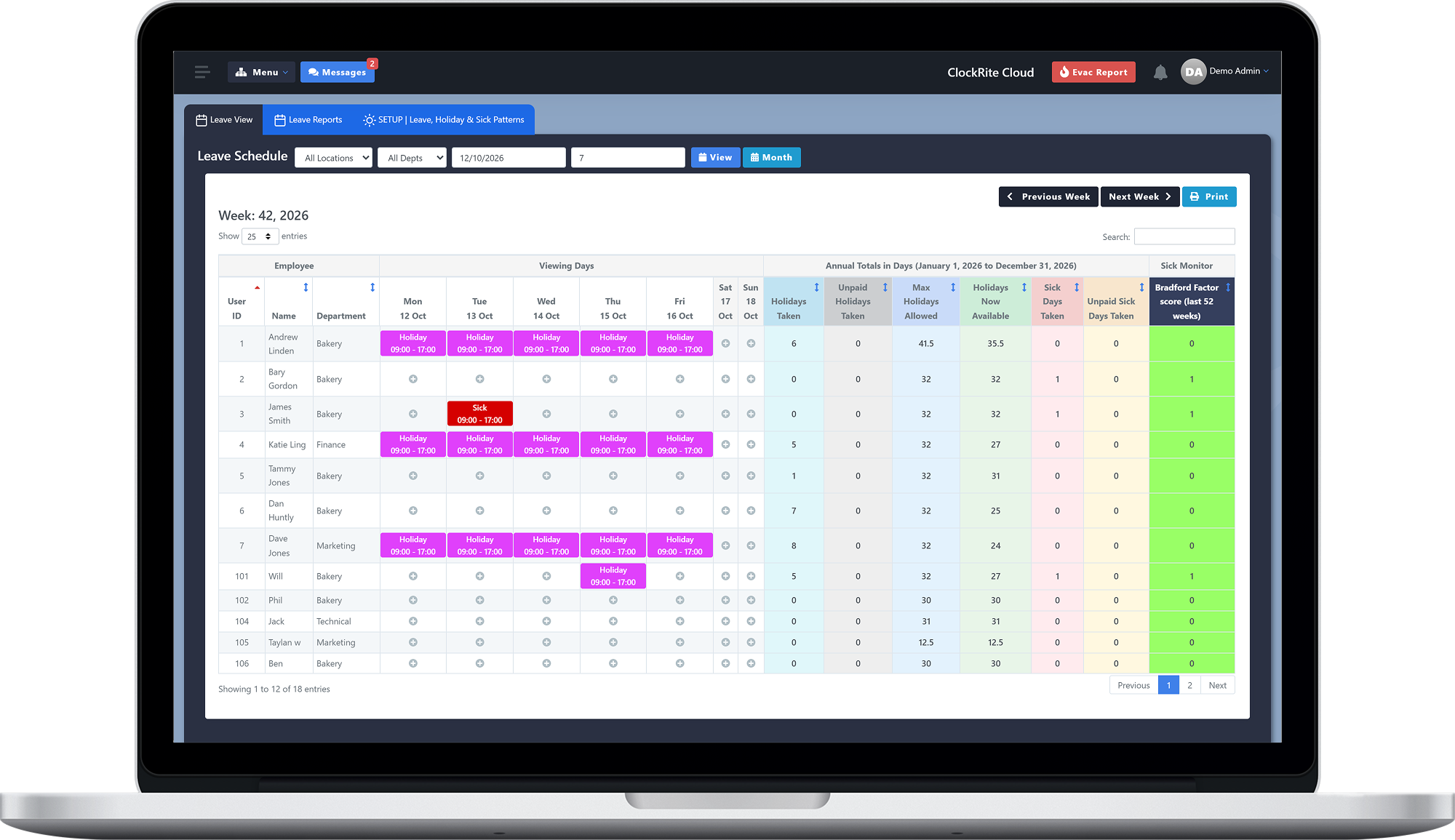
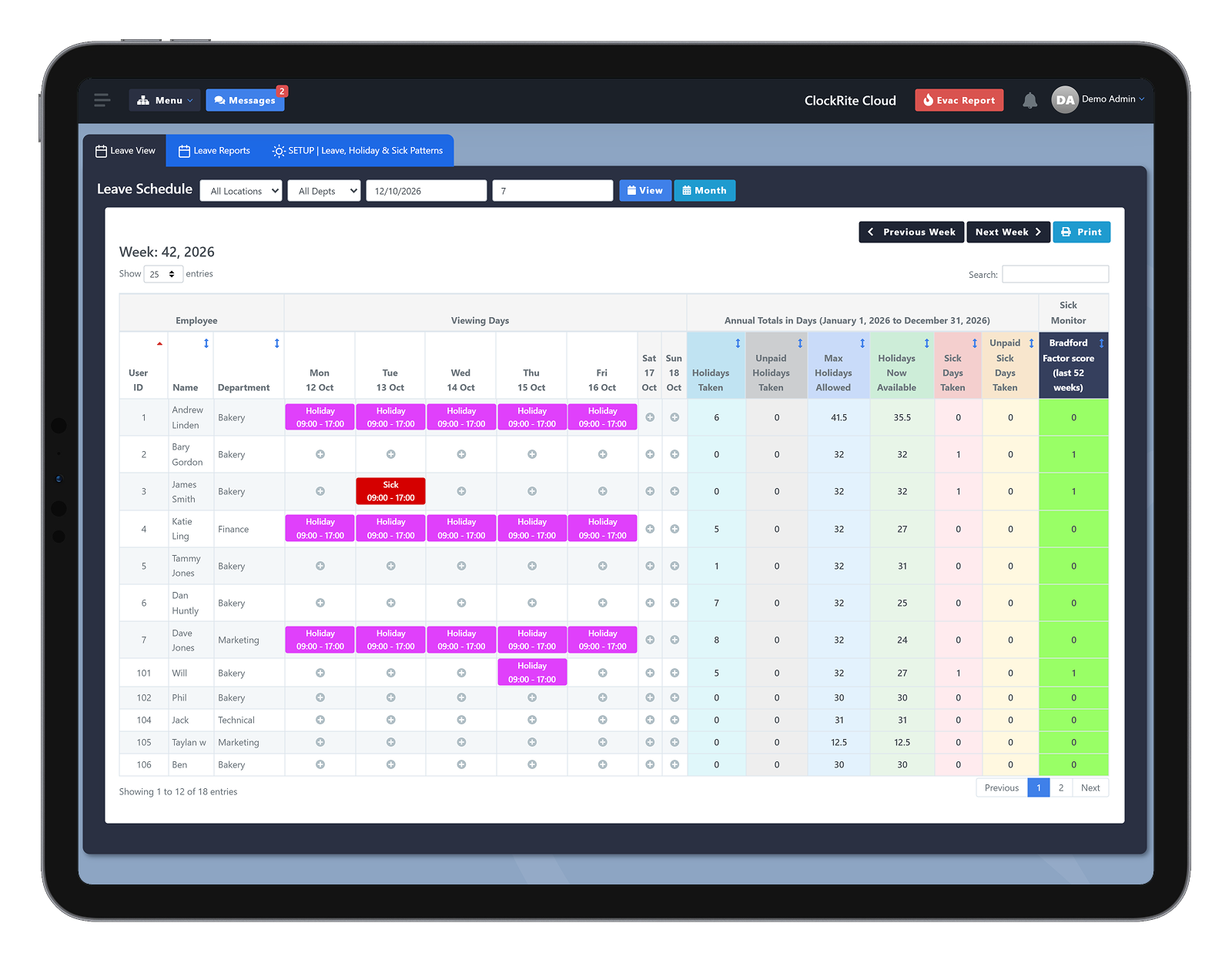
A Bradford score is only as fair as the absence records behind it. ClockRite Cloud keeps holiday, sickness and unpaid leave for every employee in one place, and works out each person’s Bradford score over the last 52 weeks, so nobody has to count spells by hand.
Why ClockRite
Absence records you can rely on
More than 5,000 businesses trust ClockRite, and we have helped UK businesses with time and attendance since 1999. Our UK-based support team can help you set up leave and absence so every score is worked out the same way, for everyone.
5,000+
Businesses trust ClockRite
55+ years
Combined experience of our current team
Since 1999
Helping UK businesses with time and attendance
UK based
Support team and UK hosted software
4.8
Average rating on Google reviews
52 weeks
Rolling Bradford score on every employee profile
FAQs
Bradford Factor questions
Can’t see yours? Call our sales team on 01246 948451 or email [email protected].
What is the Bradford Factor?
A way of scoring an employee’s absence that gives more weight to frequent short absences than to one longer absence. Employers use it to spot patterns of unplanned absence and decide when to have a conversation about it.
What is the Bradford Factor formula?
S² × D = B. S is the number of separate absences (spells) in the period, D is the total days absent across all of them, and B is the Bradford Factor score.
How do I work out a Bradford score?
Count the separate absences in the period, square that number, then multiply by the total days absent. Three absences adding up to six days scores 3 × 3 × 6 = 54. Or use the calculator on this page.
What is a good Bradford Factor score?
Under 50 is generally treated as good, and many employers take no action at that level. There is no official scale, though: the trigger points in your own absence policy are the only ones that apply.
What is a high or bad Bradford Factor score?
Many employers hold a first formal absence review somewhere around 200, and scores above 400 often lead to a formal review. A high score should start a conversation about what is behind the absences, not a sanction.
What period does the Bradford Factor cover?
Usually a rolling 52 weeks, so each absence stops counting 52 weeks after it happened. Some employers use the calendar or financial year instead. Whichever you choose, use the same period for everyone.
Does holiday count towards a Bradford score?
No. Booked and approved holiday is planned time off, not absence. The score is meant for unplanned absence, such as sickness. Check what your own policy counts.
Should absence for disability or pregnancy count?
Pregnancy-related absence should not count towards a trigger point. For disability, employers must consider reasonable adjustments, which can include leaving disability-related absence out of the score or setting a different review point.
Is it legal to use the Bradford Factor in the UK?
Yes. No law prevents it, but it must be applied fairly and consistently, and it must not discriminate against people with protected characteristics under the Equality Act 2010. This is general guidance, not legal advice.
Can someone be disciplined because of their score?
A score on its own should not decide anything. Acas advises that reaching a review point should start a review, and any formal step should follow a fair process that looks at the reasons for the absence.
Why is it called the Bradford Factor?
It is named after the University of Bradford’s School of Management, where research in the 1980s looked at the effect of short, frequent absences on organisations.
Can ClockRite work out Bradford scores automatically?
Yes. ClockRite Cloud shows each employee’s Bradford score for the last 52 weeks on their profile and in the leave schedule, worked out from the absence recorded for them. See our absence and leave page for more.